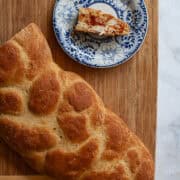
Gluten Free Challah
A gum-free recipe for a beautifully soft loaf of gluten free challah that's easy enough even for novice gluten-free bread bakers.
Servings: 10 servings
Calories: 258kcal
Ingredients
- 4 cups gluten free bread flour (480 grams)
- 1 cup water lukewarm
- 2 large eggs
- 1 large egg yolk
- ¼ cup vegetable oil
- ¼ cup granulated sugar
- 2 teaspoons instant yeast
- 1 teaspoon fine sea salt
Instructions
- In a large bowl, mix together the 4 cups gluten free bread flour, 1 cup water, 2 large eggs, 1 large egg yolk, ¼ cup vegetable oil, ¼ cup granulated sugar, 2 teaspoons instant yeast, and 1 teaspoon fine sea salt. Use a spoon or the flat beater attachment (if using a stand mixer) until a sticky, batter-like dough forms. This will take about 1 minute.
- Cover the dough and set aside for 20 minutes. It should now be firmer and less sticky. If it's still really sticky, place the bowl in the fridge for 15 minutes.
- Transfer the dough to a lightly greased surface (I used a plastic cutting board). Now, fold the dough in half towards you, pat it down, rotate the dough a quarter turn, and fold again. Repeat this pattern until the dough feels smooth and a bit firmer, about 10 more times. Add more oil as needed to the work surface to prevent sticking.
- Transfer the dough to a bowl, cover, and let it rise for about 40 minutes, until puffy and about 1 ½ times its original size. Line a baking sheet with parchment.
- On the greased surface, gently deflate the dough and repeat the kneading motion 5 to 6 more times to bring the dough together in a smooth dough ball.
- Divide the dough into 3 equal pieces and roll them into 3 logs about 14" long. Transfer the logs to the prepared baking sheet. Pinch them together at one end and then loosely braid, pinching them together at the other end.
- Lightly cover the loaf and allow to rise for 15 to 25 minutes, or until just puffy. Preheat the oven to 350℉. Before placing it in the oven, you can brush the surface with an optional egg wash.
- Place the challah in the oven and bake for 30 to 40 minutes, until browned. To make extra sure it's done, you can test with a digital thermometer, which will read between 190°F and 205°F when the loaf is fully baked.
- Remove the challah from the oven and cool completely before slicing.
Notes
- Let the dough hydrate. Rest the dough for at least 20 minutes so that it can properly hydrate and firm up. You may also benefit from chilling the dough in the fridge for 15 minutes. Depending on the temperature in my kitchen, the fridge can really help the dough come together, so if you find your dough is too sticky to work with, pop it in the fridge for a bit.
- Don't expect it to handle like wheat dough. Gluten-free bread dough, while workable, is of course vastly different than a dough made with wheat flour. It's more delicate and definitely doesn't have that stretchy texture. This is normal!
- Fold, don't knead. A technique that can help create lovely air pockets and a more familiar bread-like texture is to fold the dough rather than to vigorously knead it. I've given instructions on how to do this in the recipe card.
- Use oil. I've tested this recipe using various techniques for forming the dough, and I prefer to lightly grease the work surface with olive oil rather than dusting it with flour. I find this works better to keep the dough from sticking.
- Form as a circle. You can also make a round loaf of challah. The easiest way to do this is to roll the dough into a cylinder, then coil it up. For a prettier, braided round challah braid, you will need to form the dough into more strands, then braid them together in a pattern (see online tutorials to guide you!).
- Use a thermometer to test for doneness. This is helpful with all bread-baking in general, but especially with gluten-free bread baking! Gluten-free bread is fully baked when a thermometer reads 190°F to 205°F.
- Freeze it pretty soon after baking. Like most gluten-free breads, this challah is best enjoyed on the day it's made - it's so soft and tender! However, it will quickly dry out the longer it's left at room temperature. Freeze slices so that you can enjoy them any time, and they will taste fresh once defrosted or toasted.
Nutrition
Calories: 258kcal | Carbohydrates: 45g | Protein: 4g | Fat: 7g | Saturated Fat: 1g | Polyunsaturated Fat: 3g | Monounsaturated Fat: 2g | Trans Fat: 0.04g | Cholesterol: 58mg | Sodium: 238mg | Potassium: 29mg | Fiber: 1g | Sugar: 5g | Vitamin A: 78IU | Vitamin C: 0.01mg | Calcium: 9mg | Iron: 0.2mg