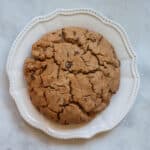
Gluten Free Barm Brack (Báirín Breac)
This recipe is adapted from Malachi McCormick’s Irish Country Cooking. It features a traditional Irish Barm Brack sweet bread studded with raisins.
Servings: 12 servings
Calories: 371kcal
Ingredients
- 1 package active dry yeast
- ¼ cup granulated sugar
- 1 cup lukewarm milk
- 4 ½ cups oat flour, 560 grams
- 1 teaspoon fine sea salt
- 1 teaspoon cinnamon
- 1 teaspoon nutmeg
- 1 teaspoon ground allspice
- ½ cup softened unsalted butter
- 2 eggs, beaten
- 1 ½ cups golden raisins
- ¾ cup raisins, or dried currants
Instructions
- In a large bowl mix the yeast with the teaspoon of sugar and ¼ cup of the milk. Set aside to proof.
- In another bowl mix 3 ½ cups of the flour, salt, and spices together. Blend in the butter with your fingertips, then blend in the sugar.
- When the yeast mixture has begun to bubble, stir in the remaining ¾ cup milk and beat in the eggs. Add the flour mixture and mix well with a wooden spoon. Add enough additional flour to form a ball of dough and stir together. Stir in the raisins, currants. At this point the dough will still be fairly wet. Place it in the fridge for 15 minutes.
- Take the dough out of the fridge and knead it in the bowl, then turn out onto an oat-floured-surface to finish. Gently knead the dough together until it is smooth and fairly firm but not stiff. Cover the bowl with a clean towel and set aside in a warm place until the dough has doubled in size, about 1 hour.
- Butter and line a 10-inch round baking pan with parchment paper. Punch down the dough and transfer it to the pan. Cover and allow to rise for 30 minutes.
- Preheat oven to 350℉. Bake for 1 hour, until browned. Turn out onto a wire rack and allow to cool completely.
Notes
- Heat the milk: The milk should be lukewarm to proof the yeast, not too hot and not too cold. If you find it difficult to assess the right temperature, use a thermometer: the milk is at the proper warmth when the thermometer reads about 100℉-110℉.
- Use fresh yeast: If the yeast doesn't get foamy after about 5-10 minutes of proofing time, discard it and use a fresh packet. This is so important- fresh yeast is essential to help the bread rise.
- Rest the dough: As noted, when you combine all of the ingredients, the dough will be sticky. It's tempting to dump in some more flour, but try to resist! As in my oat flour cinnamon rolls recipe, you want the bread to be fluffy and not overly dense. Let the dough rest in the fridge for about 15 minutes if you find it too sticky to handle. It should be easier to work with after the oat flour hydrates.
- Don't add too much flour: Again, carefully add in a little more flour as needed to create a firm yet pliable dough. Hold back in adding the flour so that the dough doesn't take too much. You won't need to manipulate the dough as much as you would with a regular dough because the lack of gluten means you don't have to activate the gluten through kneading.
- Try honey or maple syrup: I've also made this brack with honey added instead of sugar, and I love the subtle floral sweetness the honey adds to the loaf.
- Use currants: Traditional barm brack contains currants, although I had trouble finding them. If you can, use them instead of the regular raisins.
- Make it dairy-free: Make this a gluten and dairy-free barm brack by swapping your favorite plant-based milk for the milk.
Nutrition
Calories: 371kcal | Carbohydrates: 56g | Protein: 9g | Fat: 13g | Saturated Fat: 6g | Polyunsaturated Fat: 2g | Monounsaturated Fat: 4g | Trans Fat: 0.3g | Cholesterol: 50mg | Sodium: 288mg | Potassium: 419mg | Fiber: 4g | Sugar: 22g | Vitamin A: 317IU | Vitamin C: 1mg | Calcium: 77mg | Iron: 2mg